
The short answer
Yes, when used as directed.
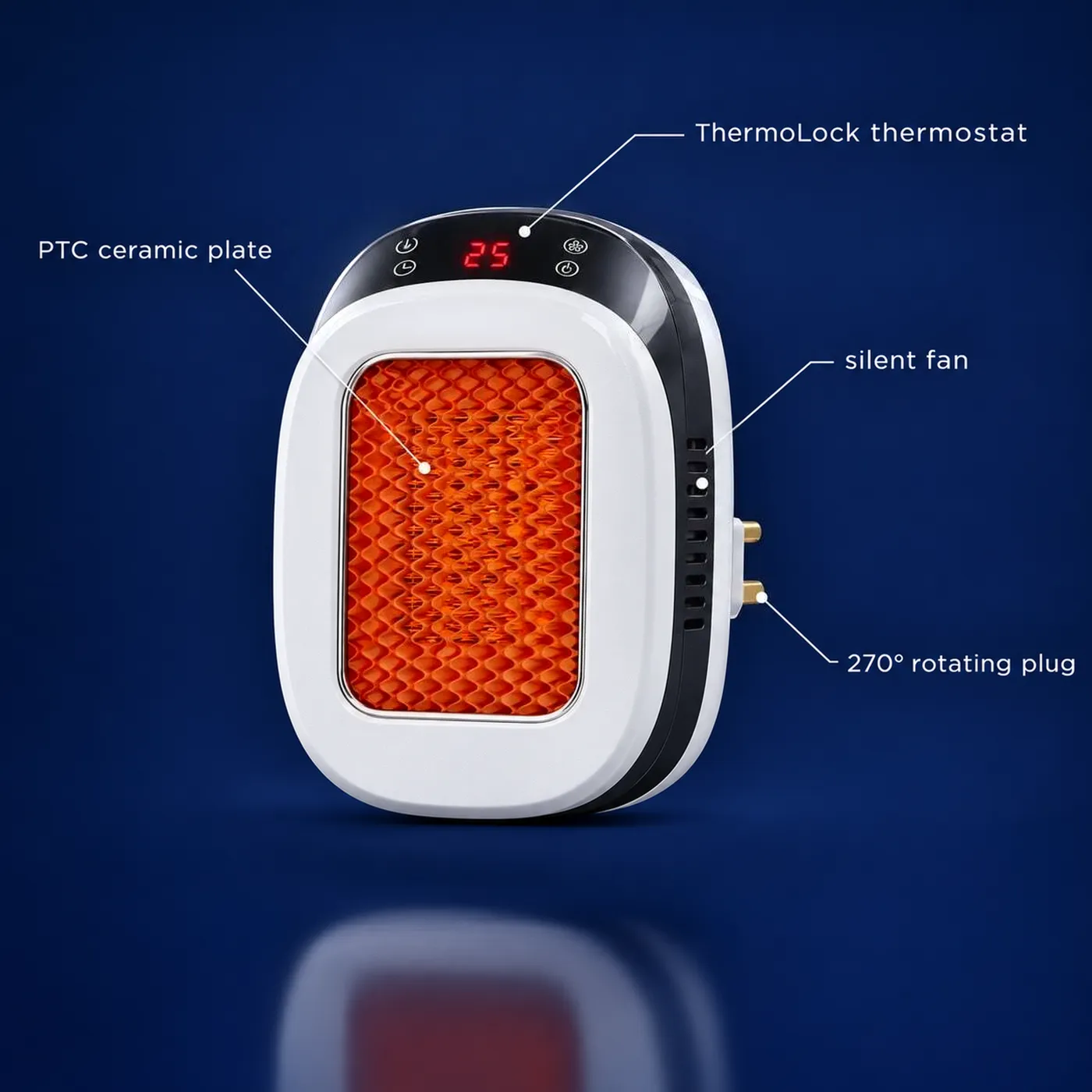
Varmo has an overheat cut-out, a self-regulating PTC ceramic element, a 6–12 hour auto-off timer and is CE & UKCA marked. Use it in a wall socket, keep it clear, and switch it off before bed.
See safety features- Free tracked UK deliveryDispatched from our UK team
- Money-back guaranteeTry it on your own meter
- Secure checkoutEncrypted, powered by Shopify
- CE & UKCA markedOverheat cut-out built in


6 built-in safety features
Overheat cut-out
If the heater gets too hot inside, for example because it's been covered, it switches itself off.
Protects against the most common heater accident.
Self-regulating PTC element
The ceramic element limits its own temperature and has no red-hot glowing bars.
Less risk than old bar fires or halogen heaters.
6–12 hour auto-off timer
Set it and Varmo switches off on its own, even if you forget.
A handy back-up, not a reason to leave it unattended.
No trailing cable
Varmo plugs straight into the wall socket, so there's no lead across the floor.
Nothing to trip over, and no cable for pets to chew.
CE & UKCA marked
Carries the UK and European conformity marks for electrical products.
Shows it's made to meet UK safety rules.
ThermoLock thermostat
Holds the room at your chosen 15–32°C instead of running flat out.
Keeps the room comfortable, never overheated.
See it up close
Varmo vs older heaters: safety compared
| Varmo | Halogen | Bar fire | Fan heater | |
|---|---|---|---|---|
| Red-hot glowing element | No | Yes | Yes | No |
| Trailing cable on the floor | No | Yes | Yes | Yes |
| Can be knocked over on the floor | No (sits on the wall socket) | Yes | Yes | Yes |
| Overheat cut-out | Yes | Varies | Varies | Usually |
| Auto-off timer | Yes, 6–12h | Rarely | Rarely | Some models |
Features of other heaters vary by model. This is a general comparison of typical types.
Safe-use checklist
Do
- Plug it straight into a wall socket
- Keep at least 1 metre clear of curtains, bedding and furniture
- Warm the room, then switch off before bed or going out
- Check the plug and socket feel firm and undamaged
- Read the manual before first use
Don't
- Use an extension lead or multi-plug adaptor
- Cover it or dry clothes on it
- Use it in a bathroom or near water
- Leave it running while you sleep or are out
- Let young children play with it
Is it safe for my family?
Older relatives
Simple remote, clear display and an auto-off timer. Show them the on/off button and talk through the safe-use rules.
Homes with children
No glowing bars and no trailing cable. Still supervise young children and choose a socket out of easy reach.
Pets
No cable to chew and nothing on the floor to knock over. Keep beds and blankets well clear of the heater.
Renters & flats
No fitting or wiring. Just use a sound, unobstructed wall socket.
Can I leave Varmo on overnight?
No. Warm the bedroom before bed, then switch Varmo off.
That's the advice of Electrical Safety First for every portable heater, not just Varmo. The auto-off timer is there as a back-up in case you forget, not as a reason to leave it running while you sleep.
Want step-by-step setup? See the Varmo instructions.
Does an auto-off timer make overnight use safe?
No. A timer only controls when the heater is scheduled to stop. It cannot check nearby fabrics, a socket fault or something blocking the airflow. The earlier overnight section should not be taken as approval to run Varmo while asleep. Follow portable-heater safety guidance and switch it off before going to bed or leaving the room.
If you want a warmer bedroom, warm it while awake and present, then turn the heater off before sleeping. Keep bedding and clothing away throughout. Where someone needs reliable warmth overnight for health reasons, seek advice on a suitable heating arrangement rather than relying on a small portable heater. Older people and those with health conditions may need more support to keep warm. Safety features are helpful, but they do not replace supervision or an appropriate home-heating plan.
What does cool-touch casing actually mean for safe use?
It describes the casing, not every surface or the air leaving the heater. Do not assume the grille, outlet or nearby objects will remain cool. A child or pet can still be harmed by contact or close exposure. Keep hands, toys, blankets and loose materials away and supervise anyone who may not recognise the risk.
Cool-touch wording also does not allow smaller clearances than the manual specifies. Heat can build up if airflow is restricted, and fabric can move after you first position the heater. Think about a curtain blowing across it or a duvet slipping from a bed. A safe setup must remain clear during use, not merely look clear at the moment you switch on. If the room layout cannot provide that, use another heating arrangement rather than relying on the casing description.
How do I know whether my wall socket is suitable?
Look for a secure socket without cracks, discolouration, scorch marks or a loose fit. The heater should sit as intended without sagging or putting strain on the connection. Do not use a socket that sparks, smells burnt or feels unusually hot. Stop using it and ask a qualified electrician to investigate rather than trying a different angle.
The 270° rotating plug helps with orientation, but it is not a workaround for poor access or damaged wiring. Keep the heater directly connected to a suitable wall socket. Do not add an extension lead, multiway adaptor, travel adaptor or improvised support. If furniture prevents safe positioning, move the furniture or choose another heating method. Do not leave the heater squeezed into a gap just because its compact size makes the plug physically reachable.
Can I use Varmo in a bathroom or near a sink?
Do not assume a heater is suitable for a bathroom, kitchen splash area or other damp location. Water and electricity create additional risks, and a UK three-pin plug does not establish suitability for wet areas. Use only locations expressly permitted by the supplied manual and applicable electrical safety requirements. If the instructions do not clearly allow the intended use, do not proceed.
Never handle the heater with wet hands or place it where it could be splashed. Do not use an extension from another room to reach a bathroom. A heater that has become wet should remain unplugged; drying the outside is not proof that internal parts are safe. Ask the seller or an appropriately qualified professional for advice. For regular bathroom heating, a properly selected and installed solution is more appropriate than improvising with a portable plug-in heater.
What should I do if the overheat cut-out operates?
Treat an unexpected shutdown as something to understand, not a nuisance to defeat. Switch off, unplug when safe and allow the heater to cool. Check for an obvious obstruction only after it is cool and disconnected. Follow the manual's procedure. Do not insert tools through the grille or try to bridge, disable or repair the protective device.
If the heater repeatedly cuts out, keep it out of use and contact support. Repeated restarting can hide a continuing problem with airflow, positioning or the unit itself. Smoke, sparking, a burning smell, melted plastic or a hot socket need particular caution. If there is a fire, get everyone out, stay out and call 999. Do not risk touching a smoking appliance or use water on an electrical fire. A cut-out reduces certain risks; it cannot guarantee safety in every fault.
How can I make heater use safer around children and pets?
Choose a position they cannot easily touch, cover or interfere with, while still meeting all placement instructions. A wall socket can be low enough for a toddler or pet to reach. Having no trailing cable removes one possible hazard, but it does not remove heat, impact or obstruction risks. Do not describe the heater as childproof.
Supervision matters even when the casing is cool-touch. Keep toys, pet beds and loose bedding away. Store the remote securely and keep replacement batteries out of reach, especially button batteries. Someone who cannot understand the controls should not be left responsible for operation. If a safe separation is not practical in the room, choose another arrangement. Do not build an improvised cover around the heater, as that can block airflow and create a new hazard.
What do safety markings tell me before I buy?
Varmo is described as CE and UKCA marked. These markings relate to conformity with applicable requirements, not an independent consumer recommendation or a promise that no fault can occur. They do not tell you whether an individual heater has been damaged in transit or whether your intended location is appropriate.
Before use, check that the product information is readable and the supplied instructions explain safe operation. Keep the order details so you can contact the seller about a defect. A money-back guarantee concerns the purchase; it is not a substitute for safe use. Do not keep operating a damaged heater because a return is available. For someone who needs heat continuously or cannot supervise a portable appliance, consider a more suitable fixed or professionally advised option rather than relying on labels alone.
Who it is not for
We'd rather you buy the right heater than return the wrong one. Varmo is probably not for you if:
- You need heat that operates while everyone is asleep or away.
- Children or pets cannot be kept safely away from the heater.
- Your only socket is damaged, loose or obstructed.
- You need to use it near water without explicit approval in the manual.
More questions answered
Sources
Facts on this page were checked against these independent sources. Energy prices use the Ofgem price cap for 1 October to 31 December 2026.
Get your Varmo
Launch price: half off. Buy more and pay less per heater.
You'll pay £99.00 today · Free tracked UK delivery · No subscription
Secure checkout by Shopify
- Free tracked UK delivery
- Money-back guarantee
- Secure Shopify checkout