
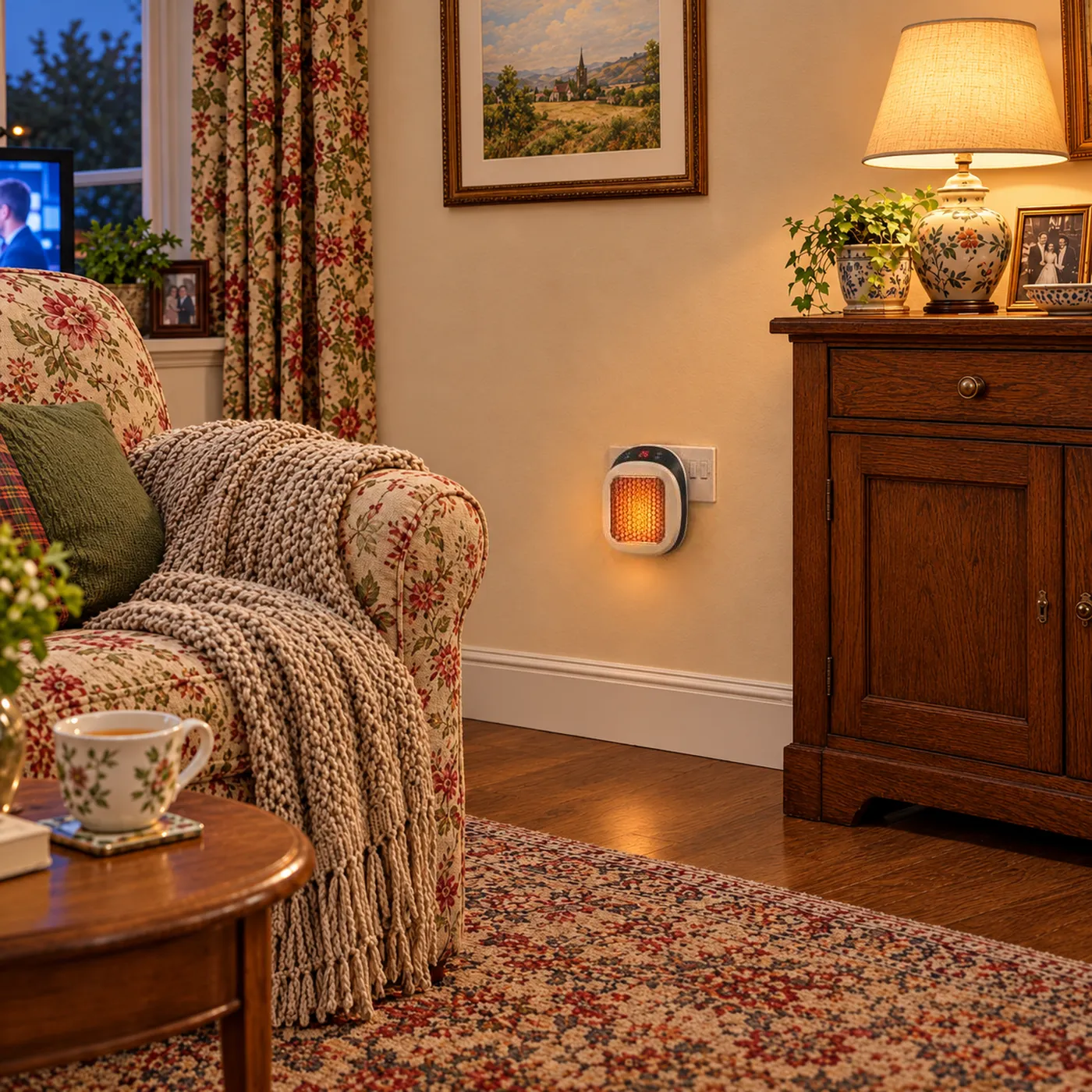
What is a plug-in heater?
Quick answer
A plug-in heater is a small electric heater that plugs directly into a wall socket. Most use a ceramic (PTC) element and a quiet fan to warm one room quickly.
What to look for
- Wattage: 400–800 W keeps running costs low
- A digital thermostat so it isn't running flat out all the time
- A timer so it switches itself off
- Overheat protection and UKCA marking
- A rotating plug so it fits any socket
- A remote control so you don't have to reach the socket
Are plug-in heaters any good?
For heating one normal-sized room, yes. They're cheap to buy, cheap to run and need no installation. They won't replace central heating for a whole house, and very large rooms may need two.
Our pick: Varmo
Varmo ticks every box above: 600 W, a ThermoLock thermostat (15–32°C), a remote, a 6–12 hour timer, a 270° plug and an overheat cut-out, for £59 or less.
Frequently asked questions
How do I know whether a plug-in heater will suit my room?
Start with the room, rather than the product page. Note whether it has outside walls, a high ceiling, large windows or a door that is often open. These affect how quickly warmth escapes. Two rooms with the same floor area can need very different amounts of heat. There is no honest universal room-size promise based on wattage alone.
Think about the coldest conditions in which you will use it. A heater that feels comfortable on a mild autumn afternoon may not keep up during a frosty evening. Varmo's stated 10–15 minute warm-up is a guide for a normal room, not a guarantee for every building. If the room stays cold while the heater runs continuously, do not assume a higher thermostat setting will solve the problem. You may need better draught control, more heating capacity or your main heating system.
Where should a wall plug heater go?
Check the available socket before ordering. It needs to be sound, firmly fixed and in a position that allows the appliance to sit as its instructions require. Look above, below and in front of it. A curtain can move when a door opens, and a chair can be pushed back into a previously clear space.
A rotating plug helps with orientation, but it does not make every socket suitable. Do not squeeze the heater behind a sofa, use an adaptor to change its position or support it with an extension lead. Keep the manual's clearances even if this means using a different room. Where there is no suitable wall position, a freestanding heater in a safe location may be the more practical choice. Neither a convenient remote nor a compact casing removes the need for clear airflow.
What should I check before buying a heater online?
Look for a clear product identity, readable instructions, electrical rating and a way to contact the seller. Check the returns process before paying. Keep the order confirmation and product details so that you can identify what was supplied if a problem appears later. Avoid choosing solely on a dramatic discount or a claim that one small appliance will replace whole-home heating.
CE and UKCA markings concern conformity requirements; they are not independent customer reviews or proof that an appliance suits every setting. Varmo is sold only through getvarmo.co.uk, using secure Shopify checkout, with free tracked UK delivery and a money-back guarantee. Read the guarantee terms rather than assuming a particular return period. One costs £59, two £99, three £139 and four £175. A multipack is only useful if you have a genuine need and suitable sockets for each unit.
How do I use the thermostat without wasting heat?
Choose a temperature that feels comfortable, then give the room time to settle. Turning the setting up to its maximum does not increase a 600 W heater's maximum heating power. It mainly asks the heater to keep working towards a higher temperature. Avoid changing the setting every few minutes, as this makes it harder to judge whether the room is becoming comfortable.
The thermostat senses conditions near the appliance. A separate room thermometer near your usual seat can help you judge comfort away from the socket, without placing it in the hot airflow. There is no fixed cycling pattern that applies to every room. A well-insulated room may need short bursts of heat; a cold, draughty room may need continuous output. A timer is a separate control. Use it to limit a session, but switch off yourself when you finish using the room.
Is ceramic heating better than an oil-filled radiator?
The main difference is how the heat reaches you and how quickly the appliance responds. A ceramic fan heater moves warm air into the room. An oil-filled radiator warms its internal oil and metal body before releasing heat. The radiator may continue feeling warm after switching off, but that warmth was paid for while it heated up. It is not free extra energy.
For ordinary direct electric heaters, almost all the electricity becomes heat indoors. A ceramic element does not create more heat from each unit of electricity than an oil-filled radiator. Choose between them on practical grounds: response, position, noise, controls and storage. Varmo's PTC plate reaches full heat in about eight seconds, but warming the air, furniture and walls takes longer. An oil-filled radiator can still be a sensible choice for someone who prefers a fan-free appliance and has enough safe floor space.
What should I do during the first heating session?
Read the supplied instructions before connecting the heater. Check the casing, plug and socket for visible damage. Remove packaging, arrange the required clear space and stay present during the first session. Learn which control changes the temperature, which sets the timer and how to switch the unit off. A remote is helpful, but you should also know how to operate the touch panel.
Stop using the appliance if you notice a burning smell, smoke, discolouration, crackling or unusual heat at the plug or socket. Do not repeatedly reset a safety cut-out without finding the cause. After ordinary use, let the heater cool before moving or cleaning it, following the manual. Keep these instructions somewhere easy to find. If someone else will use the heater, show them the safe position and controls rather than assuming they will understand the display.
| Format | Useful when | Main limitation |
|---|---|---|
| Direct-to-socket heater | A suitable wall socket has clear space around it | Position depends on the socket |
| Freestanding fan heater | You need a choice of safe floor positions | Requires floor space and cable management |
| Oil-filled radiator | You prefer steady warmth without a fan | Bulkier and slower to respond |
| Fixed room heating | You need regular, planned heating | May involve installation and higher initial cost |
Pros and cons
Good points
- No trailing power cable when connected directly to a suitable socket.
- Compact enough to store when not needed.
- Can provide supplementary heat without a permanent installation.
Things to know
- Furniture and socket position may rule out the room you hoped to heat.
- A small heater may struggle when outdoor temperatures fall.
Who it is not for
We'd rather you buy the right heater than return the wrong one. Varmo is probably not for you if:
- You need one appliance to heat several connected rooms.
- Your only available socket is behind furniture or near hanging fabrics.
- You want an appliance to leave running while the home is empty.
More questions answered
Sources
Facts on this page were checked against these independent sources. Energy prices use the Ofgem price cap for 1 October to 31 December 2026.
Ready to warm the room you actually use? See Varmo bundle prices.
Get your Varmo
Launch price: half off. Buy more and pay less per heater.
You'll pay £99.00 today · Free tracked UK delivery · No subscription
Secure checkout by Shopify
- Free tracked UK delivery
- Money-back guarantee
- Secure Shopify checkout