
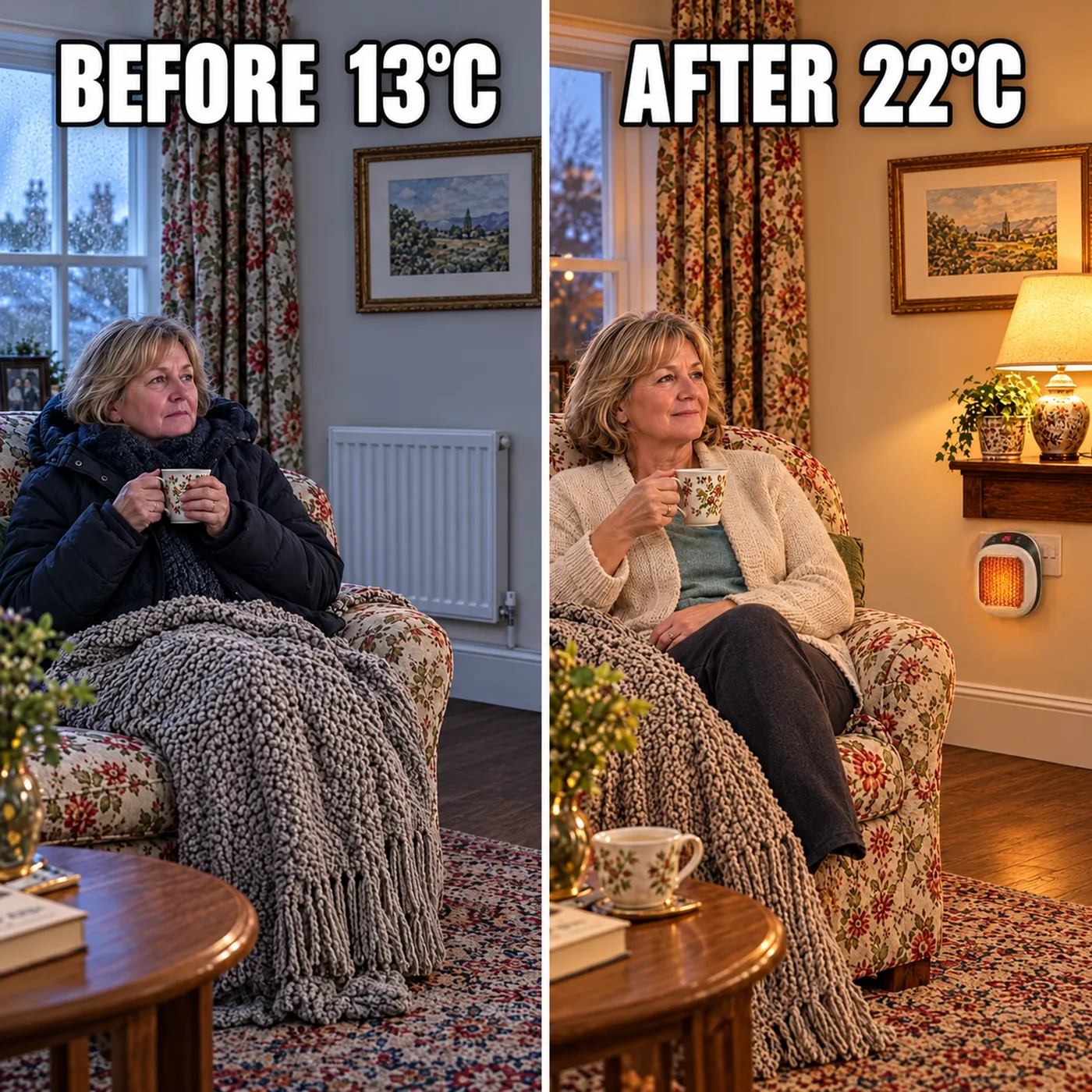
The quick answer
Quick answer
At about 26p per kWh, Varmo costs roughly 15p an hour at full power. Once the room reaches your chosen temperature, ThermoLock cycles on and off, so in a well-insulated room a whole evening can cost 30–45p.
How the maths works
- Power: 600 W = 0.6 kW
- Cost per hour = 0.6 kW × your unit rate
- 0.6 × 26p = 15.6p per hour at full power
- Once warm: around 1/6 of that each hour
What affects your cost
- Your electricity tariff
- Room size and insulation
- How cold it is outside
- The temperature you set
Running cost calculator
| Per day | Per week | Winter (26 wks) | |
|---|---|---|---|
| Varmo 600 W* | £0.26 | £1.82 | £47.32 |
| 2,000 W fan heater | £2.60 | £18.20 | £473.20 |
*Estimate: one hour at full power to warm the room, then ThermoLock topping up about 10 minutes an hour. Real costs depend on room size, insulation and outside temperature.
Get Varmo for £59Is 30–45p a reliable budget for an evening?
Not without knowing the evening's length, your tariff and the heater's actual operating time. The earlier short answer assumes substantial thermostat cycling. That is not a measured result for every room. At the scenario rate, four hours of continuous 600 W heating cost about 63p. A colder room may require continuous heat rather than brief top-ups.
Use the full-power figure as a cautious starting point for the heating element. Then compare it with actual use once you understand the room. A thermostat may reduce consumption, but no fixed ten-minute-per-hour pattern can be promised. If the room never reaches its target, there may be little opportunity for cycling off. Budgeting from a guaranteed low evening figure would hide that possibility and could leave you surprised by the bill.
How do I use my own electricity tariff?
Find the electricity unit rate on your bill or supplier account. It should be shown in pence per kilowatt-hour, often written p/kWh. Do not confuse it with the daily standing charge or your monthly Direct Debit. A Direct Debit is a payment towards your account, not the price of each unit of electricity you use.
Multiply your unit rate by 0.6 for one hour at full power. At 30p/kWh, for example, that is 18p per hour. Multiply again by the expected full-power hours. If you have a time-of-use tariff, calculate each period separately using the applicable rate. A fixed tariff may differ from the price cap. The cap also varies by payment method and region, so a national reference figure is not a substitute for checking your own bill.
Does the daily standing charge belong in the heater cost?
For the extra cost of switching on a heater in a home already connected to electricity, the standing charge is normally not an additional heater expense. You generally pay it whether the heater runs or not. Separating fixed and usage charges helps you understand what changes when you alter your heating routine.
The supplied scenario includes a 54.83p daily electricity standing charge. Adding all of that to Varmo would unfairly make one appliance responsible for a household connection cost. Equally, leaving it out of a heater calculation does not make it disappear from your total bill. If you are building a whole-home budget, include the actual standing charge once per day, alongside all electricity use. Do not count it again for every appliance or every heater in a bundle.
How much difference can the thermostat make?
At the scenario rate, an hour containing thirty minutes of full-power heating would use about 7.9p for that heating time. Fifteen minutes would be about 3.9p. These are arithmetic examples only. They do not establish that Varmo will follow either pattern in your home, and they do not separately measure any remaining control or fan consumption.
Cycling depends on the difference between heat supplied and heat lost. A well-insulated room with a modest target may need less active heating than a cold, draughty room. Opening doors, changing the target and colder weather can alter the pattern. Do not use the display setting alone as proof of consumption. To understand real use, compare energy readings over a sensible period and note other appliances operating at the same time.
Is Varmo cheaper than a 2 kW or 3 kW heater?
It costs less per hour at full power because it draws less power. It also supplies less heat during that hour. Comparing hourly prices alone can therefore mislead. If a room needs a higher heat input to stay comfortable, a smaller heater may run continuously while a larger thermostatic heater cycles. Similar heat delivered can mean similar electricity use.
All ordinary electric resistance heaters are close to 100% efficient at converting electricity into room heat. There is no special ceramic multiplier. Controls, placement and choosing a suitable output can still improve practical use. The fair question is what it costs to maintain the comfort you need, not which label has the smallest wattage. The table shows power-based costs, not equal-performance test results or proof that one heater can replace another in every room.
Can Varmo cost less than gas central heating?
Possibly, when it avoids heating much of a home unnecessarily, but not because electricity is cheaper per unit. The supplied comparison scenario uses gas at 7.97p/kWh and electricity at 26.32p/kWh. Gas input prices do not directly equal useful room-heat costs because boiler efficiency, distribution losses and system operation affect the result.
Compare a realistic household routine. If central heating can be safely lower while one occupied room is comfortable, targeted electric heat may reduce total spending. If the boiler keeps running as before, the electric heater is an added cost. Do not compare 600 W with a boiler's maximum power rating and assume the difference is saved. Consider hot water, occupied rooms and the needs of vulnerable people before changing the heating schedule.
How can I check whether my total bill is falling?
Record the heating schedule, electricity use and gas use before and after changing your routine. Note outside conditions and how many people were home. A single mild day is not a fair comparison with a cold week. Smart-meter displays can help, but whole-home readings include cooking, washing and other electrical loads.
Look at both fuels and comfort, not just the heater's low hourly figure. If electricity rises while gas falls, compare the money value of both changes using your actual tariffs. Keep safe warmth throughout the home and avoid judging success only by reduced consumption. If the room remains cold or other rooms become unsuitable, the plan needs changing. A £59 purchase is only financially worthwhile if any genuine savings eventually outweigh that upfront cost.
| Heating time | Varmo: 600 W | 2 kW heater | 3 kW heater |
|---|---|---|---|
| 1 hour | 15.8p | 52.6p | 79.0p |
| 4 hours | 63.2p | £2.11 | £3.16 |
| 6 hours | 94.8p | £3.16 | £4.74 |
| 30 days at 4 hours a day | £18.95 | £63.17 | £94.75 |
Who it is not for
We'd rather you buy the right heater than return the wrong one. Varmo is probably not for you if:
- You expect a guaranteed evening cost without measuring running time.
- You will add Varmo while leaving all existing heating unchanged and expect automatic savings.
- Your room needs more heat than a 600 W unit can supply.
How we worked this out
We multiply rated power in kW by hours at full power and the electricity unit rate. For Varmo, 0.6 × 26.32p = 15.792p per hour. For monthly examples, we multiply the unrounded daily figure by 30.
The 26.32p/kWh rate is the supplied October–December 2026 calculation scenario, not an independently verified future Ofgem announcement. Check the linked Ofgem page and your own tariff before using it for a budget.
We do not add or remove VAT from the scenario rate. Use the final VAT-inclusive unit price shown on your bill where applicable. No assumed future VAT change is needed for these calculations.
Thermostat examples describe equivalent full-power heating time. They are illustrations, not measured Varmo test results. Small control or fan consumption outside active heating is not separately quantified.
More questions answered
Sources
Facts on this page were checked against these independent sources. Energy prices use the Ofgem price cap for 1 October to 31 December 2026.
Ready to warm the room you actually use? See Varmo bundle prices.
Get your Varmo
Launch price: half off. Buy more and pay less per heater.
You'll pay £99.00 today · Free tracked UK delivery · No subscription
Secure checkout by Shopify
- Free tracked UK delivery
- Money-back guarantee
- Secure Shopify checkout