
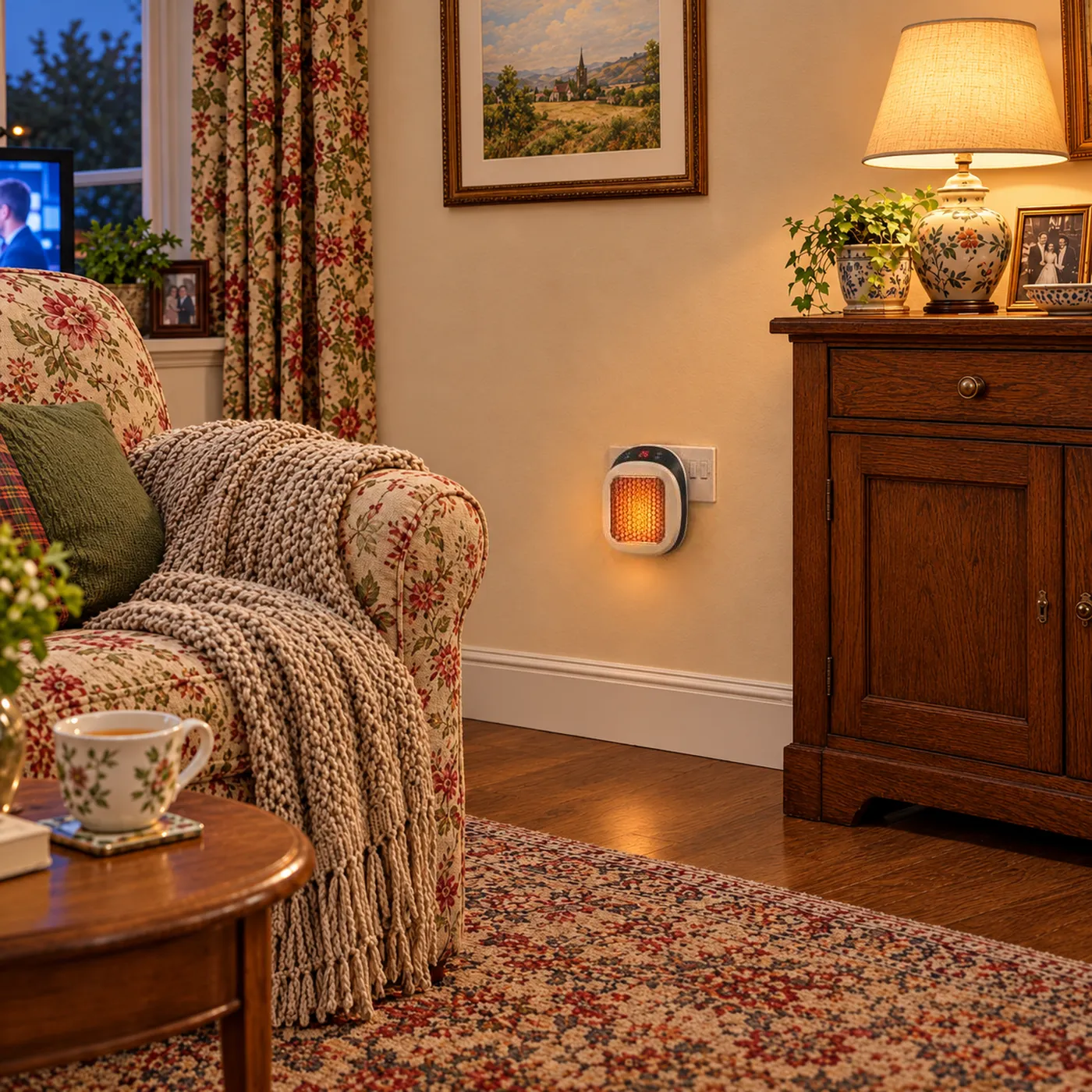
9 ways to heat one room for less
- Turn down radiators in rooms you're not using
- Close the door to keep the heat in
- Use draught excluders on doors and windows
- Draw thick curtains at dusk
- Put a rug down on bare floorboards
- Use a low-wattage heater with a thermostat
- Set a timer so heat isn't wasted
- Aim for 18–21°C rather than 25°C
- Turn the main thermostat down while you use a room heater
What's the cheapest way to heat one room?
A small, low-wattage heater with a precise thermostat, used in a room with the door closed. Varmo is built exactly for this.
Running cost calculator
| Per day | Per week | Winter (26 wks) | |
|---|---|---|---|
| Varmo 600 W* | £0.26 | £1.82 | £47.32 |
| 2,000 W fan heater | £2.60 | £18.20 | £473.20 |
*Estimate: one hour at full power to warm the room, then ThermoLock topping up about 10 minutes an hour. Real costs depend on room size, insulation and outside temperature.
Get Varmo for £59Is one electric heater always cheaper than gas central heating?
No. At the stated rates, gas costs 7.97p per kWh of fuel and electricity costs 26.32p per kWh. A boiler does not turn all its fuel into useful room heat, but gas can still be cheaper for supplying a given amount of warmth. The whole heating arrangement matters.
A room heater may save money if it allows you to avoid heating much of an otherwise empty home. It may not save if your gas system can already heat the occupied room effectively while the other radiators are controlled. Boiler settings, controls and pipework also affect the result.
Do not compare a complete day's central-heating bill with one hour of a small heater. Compare the same occupied period and suitable comfort levels. Existing heat pumps and storage heating need their own assessment because their efficiency or electricity tariff can change the calculation substantially.
How do I work out the real saving from heating one room?
Start with the change in your existing heating cost. If the central heating stays on for the same hours and at the same settings, adding a room heater may achieve little financial benefit. The additional electricity is a cost unless enough other heating is genuinely avoided.
For illustration, four hours of full-power Varmo use costs about 63p at the stated rate. If the revised central-heating routine avoids £1 of fuel use, the net energy saving is about 37p for that period. If it avoids only 40p, the new routine costs about 23p more.
Those are examples, not typical household results. Use your tariff and compare meter readings over similar weather conditions. Keep hot-water use and other large loads in mind. A short test can guide your decision, but it cannot prove what an entire winter will cost.
Which room should I choose as my main warm room?
Choose a room you can comfortably use for the intended period, not simply the smallest room available. It needs suitable seating, safe access, useful lighting and adequate ventilation. A room that forces someone to sit beside a draught or cold wall may be uncomfortable despite a warm air reading.
An enclosed room generally makes a modest-output heater more practical than a space connected to an open staircase or several doorways. Check the socket position before rearranging your routine. A plug-in heater needs clear space and cannot safely be hidden behind the furniture.
Consider the rest of the household. Another person working upstairs or an older relative in a bedroom may still need heat. Zoning is about matching warmth to real use, not treating every room outside the chosen sitting room as unoccupied or safe to leave cold.
How can I reduce draughts without making damp worse?
Deal with unwanted gaps, but distinguish them from ventilation provided for a reason. A draught around a poorly fitting door is different from an air brick, extractor or window vent. Blocking the latter may worsen indoor air quality or moisture problems and can be dangerous where combustion appliances need ventilation.
Check for straightforward defects such as damaged seals and doors that do not close properly. In rented accommodation, report maintenance issues to the landlord rather than making unsuitable permanent alterations. Choose repairs that preserve required ventilation and allow safe access.
Watch what happens after changes. More window condensation, persistent musty smells or damp patches need attention. Heating alone does not fix a leak or remove moisture from cooking and bathing. Keep appropriate extraction working and seek advice if damp persists instead of sealing more openings.
How cold can I let the rest of the house become?
There is no single temperature that suits every unoccupied room, building or plumbing arrangement. Avoid an approach that leaves people cold, allows persistent condensation or risks frozen pipes. Follow the heating system's frost-protection instructions and consider any requirements in your insurance or tenancy agreement.
For rooms in use, UKHSA recommends at least 18°C, with particular care for older people and those with health conditions. Someone who moves between rooms may need more than one warm space. Do not apply a single-room plan rigidly when health, care or mobility needs make it unsuitable.
Turning down a radiator is also not the same as safely shutting down a heating system. Controls and boiler requirements vary. If you are unsure how to create a reduced-heating schedule without causing problems, ask the installer or a qualified heating professional.
When does a 600 W heater make sense for one room?
It can make sense when a normal enclosed room needs modest supplementary heat and other heating can safely stay lower or off. Varmo provides 600 W, with a thermostat to stop unnecessary heating once the target is reached. It cannot deliver the output of a larger heater.
If the room remains cold while it runs continuously, the problem may be insufficient capacity or excessive heat loss. Setting the thermostat to 32°C will not produce more than the available power. Nor does the PTC ceramic plate create more useful heat per unit of electricity than other resistance heaters.
The practical benefits are its compact format, remote and controls where the layout suits them. The trade-offs include fixed socket location and limited output. For regular heating of a difficult room, insulation work or an appropriately sized fixed system may be the better investment.
How do I know whether buying a new heater is worth it?
Include the purchase price, not just the running cost. One Varmo costs £59. If a safe new routine genuinely saved 50p per day after paying for its electricity, recovering £59 would take 118 days of that use. This is an illustration, not a forecast of savings.
Buying several units increases available heat and total possible consumption. Two heaters running together use twice the electricity of one at the same operating pattern. A bundle discount is not a reason to heat more rooms unnecessarily or assume the appliances will pay for themselves.
First see whether existing controls can meet the need. If you do buy, read the guarantee and return terms, retain the receipt and assess comfort as well as cost. The cheapest successful arrangement is one that provides adequate warmth safely, not simply the lowest wattage on a product page.
| Daily heating time | Electricity per day | Cost per day | Cost over 30 days |
|---|---|---|---|
| 2 hours | 1.2 kWh | £0.32 | £9.48 |
| 4 hours | 2.4 kWh | £0.63 | £18.95 |
| 6 hours | 3.6 kWh | £0.95 | £28.43 |
| 8 hours | 4.8 kWh | £1.26 | £37.90 |
Who it is not for
We'd rather you buy the right heater than return the wrong one. Varmo is probably not for you if:
- You need one 600 W heater to warm a large open-plan area or several rooms.
- Other people need warmth elsewhere, so central heating cannot sensibly be reduced.
- The plan would leave occupied rooms unhealthily cold or put plumbing at risk.
How we worked this out
The table uses 0.6 kW multiplied by hours, then by £0.2632 per kWh. Thirty-day totals use unrounded daily costs and assume the same routine every day.
The electricity assumption is Ofgem's average Direct Debit rate for 1 October–31 December 2026. The corresponding gas rate is 7.97p/kWh. Electricity has no VAT during October 2026–March 2027.
No thermostat saving or boiler efficiency is assumed. The 54.83p daily electricity standing charge is excluded because it normally remains payable. These examples do not establish a saving against central heating.
More questions answered
Sources
Facts on this page were checked against these independent sources. Energy prices use the Ofgem price cap for 1 October to 31 December 2026.
Ready to warm the room you actually use? See Varmo bundle prices.
Get your Varmo
Launch price: half off. Buy more and pay less per heater.
You'll pay £99.00 today · Free tracked UK delivery · No subscription
Secure checkout by Shopify
- Free tracked UK delivery
- Money-back guarantee
- Secure Shopify checkout