
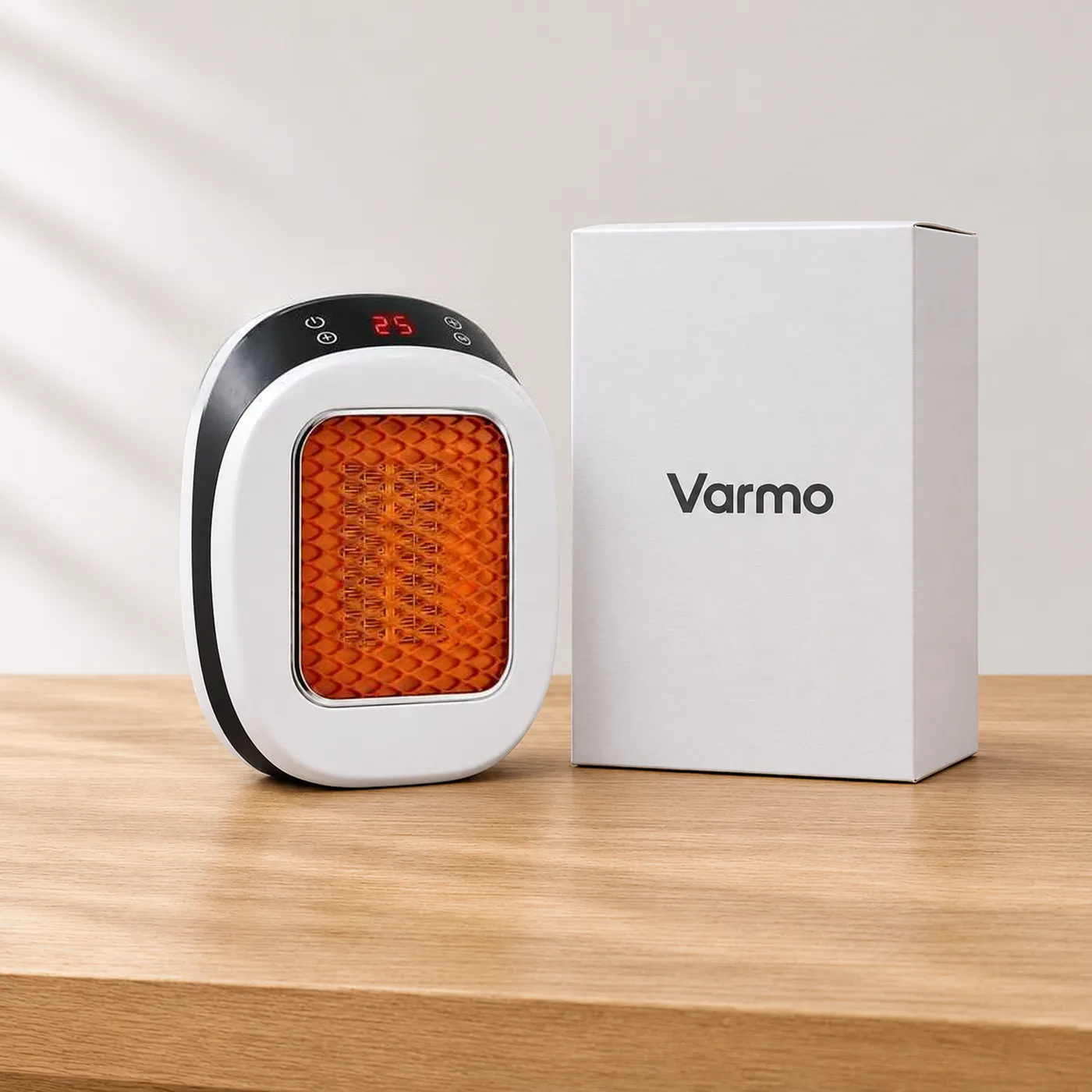
What a mini heater can do
- Warm a bedroom, office or living room
- Take the chill off in 10–15 minutes
- Cost pennies an hour to run
- Move room to room easily
What a mini heater can't do
- Heat a whole house
- Instantly warm a very large, draughty open-plan space
Do mini heaters use a lot of electricity?
No. Most mini heaters use 400–800 W, versus 2,000–3,000 W for a standard fan heater. A 600 W model like Varmo costs about 15p an hour at full power.
Can you leave a mini heater on all night?
No. Electrical Safety First advises against running portable heaters while you sleep. Warm the room first, then switch off. An auto-off timer is a useful back-up if you forget.
Frequently asked questions
Does a smaller heater always use less electricity?
Look at the rating label rather than the size of the casing. Mini is a description of the product's dimensions, not a formal energy category. A compact heater can still have a high electrical input. Wattage tells you its maximum rate of electricity use, while the length of the session tells you how much energy it uses overall.
For example, a 600 W heater running continuously for two hours uses 1.2 kWh. Another heater drawing 1,200 W uses the same amount in one hour. The smaller heater has a lower hourly demand, but it is not automatically cheaper for every heating job. If it needs to run much longer to provide enough warmth, the difference narrows. Ordinary electric heaters turn almost all their electricity into heat, so a small casing or ceramic plate does not create an extra efficiency bonus.
Why can a mini heater feel warm before the room does?
Warm airflow near the appliance can be noticeable quite quickly. That is different from raising the temperature throughout the room. Cold walls, furniture, flooring and incoming air all absorb heat. Your hands may feel a warm stream while the far side of the room remains chilly. Judge the result where you actually sit, not with a hand held close to the outlet.
Varmo's PTC ceramic plate reaches full heat in about eight seconds. Its stated room warm-up time is around 10–15 minutes in suitable conditions. Neither figure means every room reaches the chosen temperature in that time. A cold starting temperature, open doorway or draught can extend the process. If you need broad, even warmth across a large space, choose heating designed for that load rather than expecting a mini appliance to behave like a larger installed system.
Is a mini heater useful in a home office?
It can be useful when one person uses a separate room for a limited part of the day. The room should have a suitable socket, enough clearance and a heat demand the appliance can meet. Check the position of paper, bins, curtains and desk panels. A socket hidden beneath a crowded desk is not automatically a safe heating position.
Consider how you work as well as the room size. Sitting still can make you feel cold even when the air temperature seems reasonable. Comfortable clothing and reducing unwanted draughts may help without needing a higher setting. Keep necessary ventilation open. If the heater runs continuously but you remain uncomfortable, do not place it closer to your legs or cover part of the outlet to concentrate the heat. Reassess the room, the appliance position and whether your main heating would provide more suitable warmth.
Can I use a mini heater to warm a bedroom before bed?
A short, supervised session before bedtime is different from leaving a heater on while sleeping. Keep bedding, clothes and curtains away, and make sure the heater is not beside a route where someone could knock or obstruct it. Switch it off before going to sleep. A timer and an overheat cut-out are useful protections, but neither is a reason to leave a portable heater unattended overnight.
This is an important qualification to any earlier advice suggesting that a timer alone makes overnight use acceptable. Sleep removes your ability to notice a developing problem. If the bedroom needs dependable warmth through the night, review the home's main heating controls and seek appropriate advice for the household's needs. Do not rely on an unattended mini heater to protect a vulnerable person from a cold room. Warm bedding helps comfort, but it does not replace adequate room heating where that is needed.
Will a mini heater stop damp and condensation?
Heating can help keep surfaces warmer, but a mini heater is not a dehumidifier and does not remove moisture from the home. Condensation depends on moisture levels, ventilation and surface temperatures. Drying washing indoors, cooking and showering all add moisture. A heater alone cannot fix a leaking pipe, water coming through a wall or a building defect.
Keep extraction and background ventilation working as intended. Do not block airbricks or trickle vents simply to help a small heater keep up. Deal with unwanted gaps separately from planned ventilation. Never put damp clothes over the appliance or directly in its airflow to dry them. If a room repeatedly develops mould or feels wet despite sensible heating and ventilation, investigate the cause. Buying a second mini heater without understanding the moisture problem may add to the bill without solving the underlying issue.
How do I decide whether a mini heater is worth buying?
Write down the specific job you want it to do. Warming a modest study during a supervised afternoon is a clearer requirement than reducing the entire winter bill. Check that a suitable socket exists before comparing prices. Then consider how often you will use the room, whether main heating is already available and whether a different heater format would be easier to position.
For Varmo, the single-unit price is £59. Buying more units lowers the price per unit, but increases the amount you spend upfront. Do not buy a multipack just because the discount looks attractive. The useful question is whether each unit has a real purpose. Keep the packaging and order details until you have checked the product and understood the money-back guarantee. During early use, record comfort and electricity use instead of relying on a promised percentage saving or an assumed thermostat duty cycle.
Pros and cons
Good points
- Easy to store between short heating sessions.
- Useful for supplementary warmth where the socket position is suitable.
- A remote can make adjustments easier from a chair.
Things to know
- Limited heat output can be inadequate in a cold or poorly insulated room.
- A direct-to-socket design offers less freedom over positioning.
Who it is not for
We'd rather you buy the right heater than return the wrong one. Varmo is probably not for you if:
- You need dependable whole-home heating from one small appliance.
- You want a heater for an unattended bedroom overnight.
- The room loses warmth faster than a 600 W appliance can replace it.
More questions answered
Sources
Facts on this page were checked against these independent sources. Energy prices use the Ofgem price cap for 1 October to 31 December 2026.
Ready to warm the room you actually use? See Varmo bundle prices.
Get your Varmo
Launch price: half off. Buy more and pay less per heater.
You'll pay £99.00 today · Free tracked UK delivery · No subscription
Secure checkout by Shopify
- Free tracked UK delivery
- Money-back guarantee
- Secure Shopify checkout