
Worked example
Quick answer
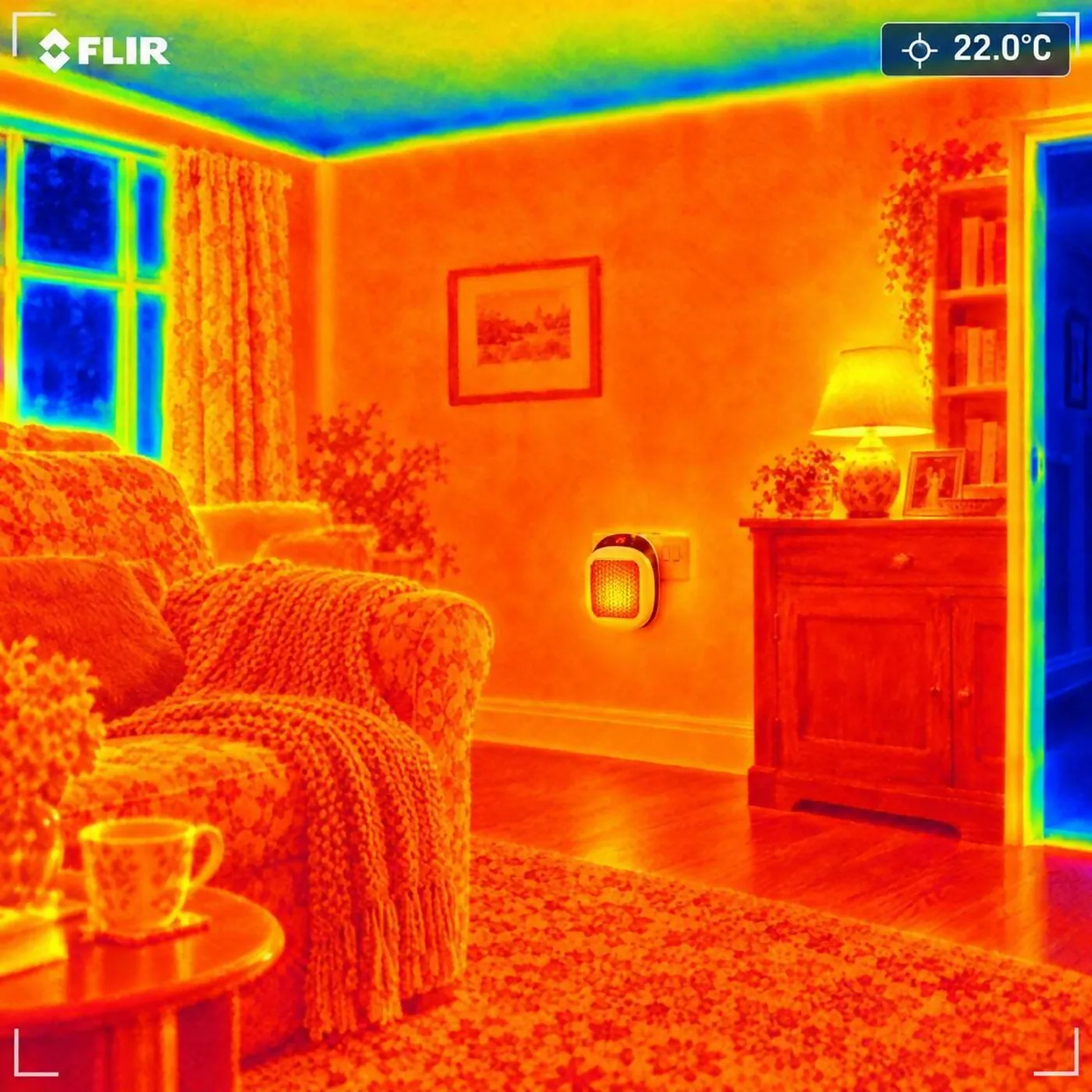
A 600 W plug-in heater at 26p/kWh costs 0.6 × 26 = 15.6p per hour at full power. With a thermostat cycling once the room is warm, a 5-hour evening in a well-insulated room can cost around 30–45p.
A 2,000 W fan heater running for the same 5 hours costs about £2.60.
Do plug-in heaters use a lot of electricity?
Low-wattage models don't. Check the wattage on the label. Anything under 1,000 W with a thermostat is economical.
Is a plug-in heater cheaper than central heating?
For heating one room, usually yes, because you're not paying to heat the empty ones. Turn your central heating thermostat down while you use it.
Running cost calculator
| Per day | Per week | Winter (26 wks) | |
|---|---|---|---|
| Varmo 600 W* | £0.26 | £1.82 | £47.32 |
| 2,000 W fan heater | £2.60 | £18.20 | £473.20 |
*Estimate: one hour at full power to warm the room, then ThermoLock topping up about 10 minutes an hour. Real costs depend on room size, insulation and outside temperature.
Get Varmo for £59How do I calculate the cost using my own tariff?
Find the electricity unit rate on your latest tariff information or bill. Use the price per kWh, not the daily standing charge or monthly Direct Debit amount. Divide the heater's wattage by 1,000 to convert it to kW. For Varmo, 600 W becomes 0.6 kW. Multiply that by the number of full-power hours and your unit rate.
If your unit rate is shown in pence, the answer will be in pence. For example, 0.6 multiplied by five hours and 26.32p gives 78.96p. Round at the end rather than rounding each intermediate step. This estimates continuous full-power operation. It is useful for budgeting without assuming generous thermostat savings. If your tariff changes by time of day, split the session into the relevant price periods. Do not use the headline benchmark when your actual rate is different.
Why is a thermostat-controlled evening harder to price?
The heater does not know that a website example allowed it ten minutes of operation each hour. It responds to the temperature it senses. Outdoor conditions, insulation, door opening and your chosen setting all affect how much heat is needed. In a room losing warmth quickly, it may run for most or all of the session.
The earlier 30–45p evening example and ten-minute cycling claim should therefore not be treated as guaranteed or measured performance. There is also warm-up energy before a settled pattern develops. A fair estimate either uses continuous full power as a simple budget or measures energy consumption in the actual room. Lower consumption is possible when the thermostat switches the element off for part of the time, but the amount cannot be promised in advance. If the room never reaches the set temperature, there may be little cycling at all.
Does five hours on mean five hours at full power?
Not necessarily. Five hours describes the session length, while full-power hours describe the equivalent time drawing the rated heating input. If the thermostat turns the heating element off for part of a session, total energy use is lower than the continuous full-power figure. Exactly how much lower depends on what happens during that session.
For illustration only, three hours of equivalent full-power operation within a five-hour session would use 1.8 kWh and cost about 47.4p at the stated rate. That is not a Varmo test result or a forecast. The fan, display and control behaviour may also differ between appliances, so a model's measured electricity use is the best guide to the complete session. Avoid turning a hypothetical duty cycle into a daily promise. Record several representative sessions before building it into a monthly household budget.
Can I measure the heater's actual electricity use?
A smart meter or home energy display can help show changes in whole-house demand. Compare readings before and during a controlled session, while remembering that fridges, cooking, water heating and other appliances can change at the same time. An in-home display may also update with a delay, so a momentary figure is not the same as total session consumption.
Do not insert a plug-in energy monitor, adaptor or extension simply to obtain a reading unless the heater's manufacturer explicitly permits that arrangement. A direct-to-socket appliance should normally remain directly connected as instructed. Supplier usage records can help with longer comparisons, but they still include the rest of the home. Note the session length, weather and comfort alongside the readings. If you also reduced gas heating, compare gas use too. Electricity alone cannot show whether the total household bill improved after changing the heating routine.
Will it be cheaper than leaving central heating on?
Sometimes, but not automatically. The supplied gas benchmark is 7.97p/kWh, much lower than the electricity benchmark used here. Boiler losses and the number of rooms being heated affect the comparison. Good central heating controls may already allow you to avoid heating unused areas, reducing the advantage of adding a separate electric appliance.
A plug-in heater is most likely to reduce costs when one suitable room needs warmth and its use allows enough other heating to stay off or lower. If the boiler continues as before, the portable heater is generally an added cost. Do not make the rest of the home uncomfortably cold to force a saving. Consider other occupants, moisture and frost-protection needs. Varmo is a room-heating option, not a promise that electricity is cheaper than gas or that every household should replace its central heating routine.
How should I budget for several heaters or a whole winter?
Multiply energy use by the number of appliances actually running. Two 600 W units operating continuously together draw 1.2 kW and cost about 31.6p per hour at 26.32p/kWh. A lower purchase price per unit in a multipack does not reduce the electricity each unit needs. Count the heaters and hours separately rather than treating the bundle as one appliance.
For a longer budget, choose a realistic number of days and allow for changing weather and tariffs. The 90-day figure in the table is an arithmetic example, not a prediction for your winter. Add the purchase price: one Varmo is £59, so the example's £71.06 electricity cost would become £130.06 including that initial purchase. Do not add the purchase price again in later years if the same unit remains in use. Review the routine after cold spells, when heating demand may differ sharply from mild autumn conditions.
| Full-power use | Electricity consumed | Cost |
|---|---|---|
| 1 hour | 0.6 kWh | 15.8p |
| 3 hours | 1.8 kWh | 47.4p |
| 5 hours | 3 kWh | 79.0p |
| 5 hours daily for 30 days | 90 kWh | £23.69 |
| 5 hours daily for 90 days | 270 kWh | £71.06 |
Who it is not for
We'd rather you buy the right heater than return the wrong one. Varmo is probably not for you if:
- You need a guaranteed daily cost regardless of weather or room conditions.
- You expect the heater to reduce bills while all other heating stays unchanged.
- Your room needs more heat than a 600 W appliance can supply.
How we worked this out
The calculation is watts divided by 1,000, multiplied by hours, multiplied by the unit price. Examples use the supplied Ofgem Direct Debit benchmark of 26.32p/kWh for 1 October–31 December 2026.
No thermostat cycling is assumed in the full-power table. The supplied rate is used without adding VAT. Check your own tariff and the Ofgem source; do not assume the October–December unit rate applies throughout winter.
The supplied electricity standing charge is 54.83p per day. It is excluded from appliance costs because it normally remains payable whether or not this heater is used. Purchase costs and other household energy use are separate.
More questions answered
Sources
Facts on this page were checked against these independent sources. Energy prices use the Ofgem price cap for 1 October to 31 December 2026.
Ready to warm the room you actually use? See Varmo bundle prices.
Get your Varmo
Launch price: half off. Buy more and pay less per heater.
You'll pay £99.00 today · Free tracked UK delivery · No subscription
Secure checkout by Shopify
- Free tracked UK delivery
- Money-back guarantee
- Secure Shopify checkout