
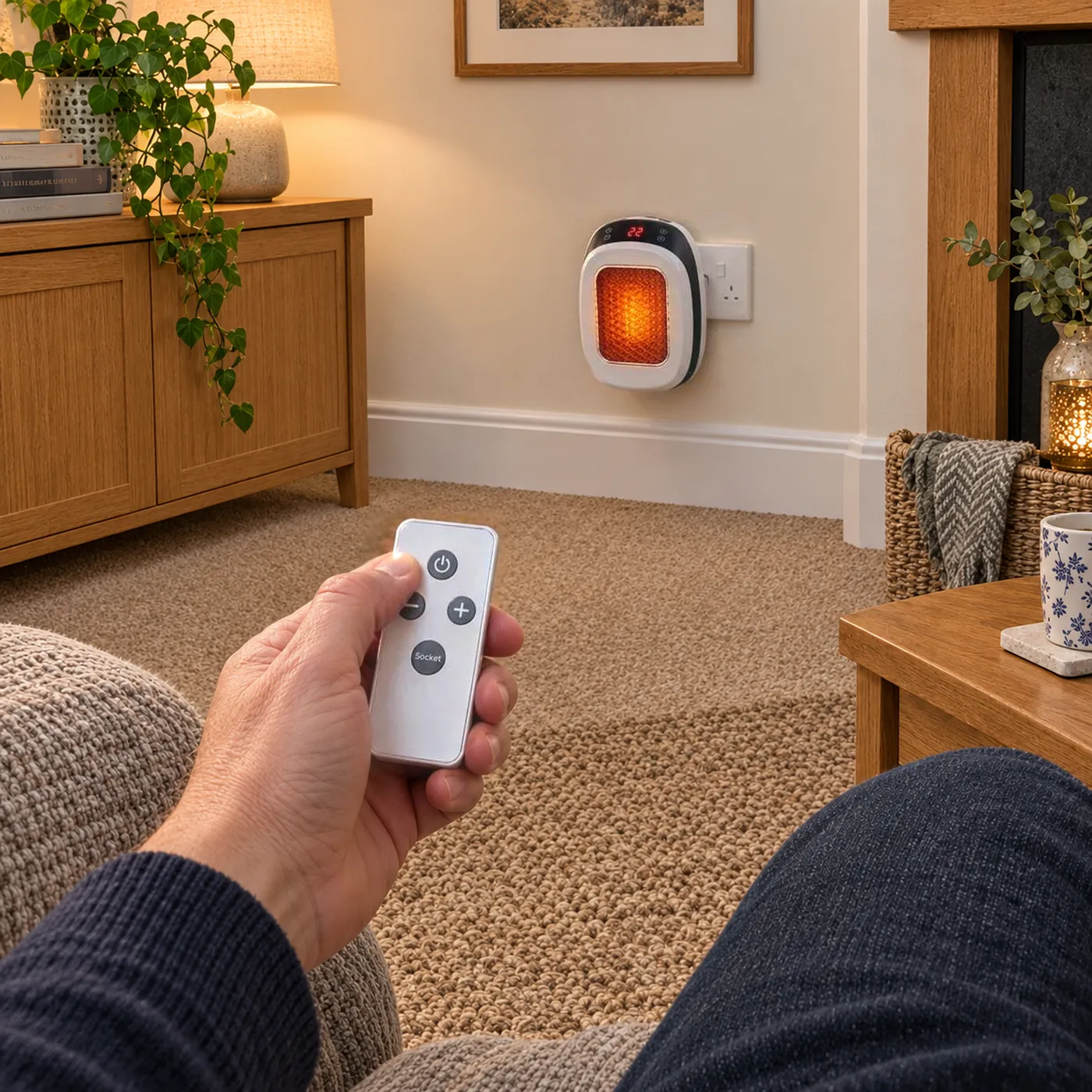
What matters for older users
- Simple controls and a large display
- A remote, so there's no kneeling at the socket
- No trailing cables to trip on
- An auto-off timer and overheat cut-out
- Low running costs so they'll actually use it
Why Varmo makes a good gift
Varmo plugs into the wall, has a remote and a timer, and costs about 15p an hour at full power. The 2-pack covers the sitting room and bedroom.
How warm should my parent's sitting room be?
UKHSA guidance recommends heating rooms people use to at least 18°C. Older adults, people with limited mobility and those with long-term conditions may be particularly vulnerable to cold. Some will need a warmer room to feel comfortable; 18°C is not a maximum or an individual medical prescription.
Check conditions where your parent actually sits, not just beside the heater. A cold window, outside wall or draught can make an armchair uncomfortable. Put a separate thermometer in a representative position, following its instructions and keeping it away from direct heat.
If the room remains below a suitable temperature despite continuous heating, the arrangement is not meeting the need. Do not simply reassure your parent that the appliance is economical. Review the heating capacity, the building and any available support, and seek health advice where appropriate.
How do I know whether a heater is easy enough to use?
Try the controls together before deciding. Ask your parent to turn the heater on, select a comfortable temperature and switch it off without prompting. Check whether they can read the display from their normal position and tell which setting is active.
A remote can be helpful, but small buttons, similar symbols and flat batteries can cause difficulty. Agree a consistent place to keep it. Varmo also has a touch panel and LED, although those features do not guarantee that every user will find it simple.
Think about how needs may change. Arthritis, reduced sight or memory problems can make yesterday's straightforward appliance confusing today. If independent use is not reliable, consider appropriate fixed heating, controls designed around the person's needs, or support from an occupational therapist rather than relying on repeated reminders.
Where can I put a heater without creating a fall or fire risk?
Walk through the room with your parent and look at their usual movements. Leave clear routes between the chair, door and walking aid. A heater that removes one trailing cable may still be poorly placed if it projects into a narrow route or obstructs a useful socket.
Keep it well away from throws, loose clothing, curtains and upholstery, using the manufacturer's clearances. An armchair blanket can slip when someone stands up. Check the real layout when the room is being used, not only when everything has been tidied for a visit.
Use a sound wall socket directly, without an extension lead or adaptor. Varmo's rotating plug does not make a socket behind furniture suitable. Make sure your parent or a helper can safely reach the switch and disconnect the appliance when necessary.
Are cool-touch heaters safe for people with reduced sensation?
Cool-touch casing is a useful feature, but it does not mean every part of a working heater is safe to touch. The outlet and outgoing air can be hot. People with reduced sensation may not notice discomfort quickly, so avoid directing heat close to their skin.
Varmo includes an overheat cut-out and carries CE and UKCA markings. These are not a promise that every use is safe, nor are the markings a personal endorsement by a medical or fire-safety organisation. Normal precautions and the operating instructions still apply.
Keep drinks, medicines and everyday items away from the appliance so nobody reaches across it unnecessarily. If your parent tends to cover appliances, move them while running or forget what is switched on, a portable heater may not be an appropriate independent heating option.
Can my parent leave a heater on when they fall asleep in a chair?
Plan around the possibility of an unplanned nap. Electrical Safety First advises against using portable heaters while asleep or leaving them unattended. If your parent regularly dozes in the sitting room, do not make a portable heater their essential source of continuous warmth.
A 6–12 hour auto-off timer is not a supervision system. It may leave the appliance operating for hours after someone falls asleep, and it does not check whether a blanket has fallen against the outlet. An overheat cut-out is also a back-up rather than a replacement for safe use.
Consider heating that can safely maintain the room under the intended conditions, with suitable installation and controls. If the existing system is broken or unaffordable, seek practical help. The answer should not be to leave a vulnerable person cold or to ignore the portable-heater precautions.
How can I help if my parent is frightened of heating bills?
Begin by asking what worries them. They may be struggling with debt, confused by a new meter or avoiding all heating after an unexpectedly high bill. Buying an appliance without discussing this may leave it unused in its box.
Show costs honestly and avoid promises that a particular heater will solve the bill. Electricity use depends on output and running time, while total savings depend on what other heating is reduced. A low-power heater that cannot keep the room warm is not a successful economy.
Offer to review the tariff and contact the energy supplier together. Ask about support for vulnerable customers and whether the Priority Services Register is relevant. Citizens Advice or Age UK can also help people explore assistance. Check current eligibility rather than promising that a particular payment or grant will be available.
What should I check after giving my parent a heater?
Arrange a follow-up after it has been used in normal conditions. Ask whether the room stays warm, whether the controls are manageable and whether the running cost causes worry. Look for changes in placement, such as the heater being moved nearer a chair or hidden behind a curtain.
Check that the plug, socket and casing remain undamaged. If there is discolouration, a burning smell, unusual noise or repeated cut-out operation, stop using it and investigate. Do not encourage your parent to keep resetting a device that appears faulty.
Keep the instructions and purchase details somewhere easy to find. Varmo is sold through getvarmo.co.uk with secure Shopify checkout, free tracked UK delivery and a money-back guarantee. Read the current terms before ordering. Buying a second unit does not remove the need to assess each room and each person's ability to use it safely.
Pros and cons
Good points
- Varmo's remote may reduce the need for repeated bending during normal adjustments.
- A suitable wall position avoids a heater cable across the floor.
- The touch panel and LED provide another way to make and check settings.
Things to know
- A low socket may still be difficult to inspect, reach or switch off.
- Someone with poor sight, memory difficulties or limited hand movement may need different controls.
- A 600 W heater may not provide enough warmth in a very cold home.
Who it is not for
We'd rather you buy the right heater than return the wrong one. Varmo is probably not for you if:
- Your parent cannot safely operate the heater or recognise when something is wrong.
- The plan depends on leaving a portable heater running while they sleep.
- There is no clear, accessible socket away from furnishings.
- The home needs reliable whole-home heating rather than a single-room supplement.
More questions answered
Sources
Facts on this page were checked against these independent sources. Energy prices use the Ofgem price cap for 1 October to 31 December 2026.
Ready to warm the room you actually use? See Varmo bundle prices.
Get your Varmo
Launch price: half off. Buy more and pay less per heater.
You'll pay £99.00 today · Free tracked UK delivery · No subscription
Secure checkout by Shopify
- Free tracked UK delivery
- Money-back guarantee
- Secure Shopify checkout