
How they differ
Quick answer
A traditional fan heater blows air over a hot wire coil. A ceramic (PTC) heater uses a ceramic plate that self-regulates its temperature.
Head to head
- Safety: ceramic plates don't glow red-hot and self-limit their temperature
- Running cost: depends on wattage; ceramic models are often lower wattage
- Smell: ceramic plates don't burn dust the way hot coils do
- Lifespan: PTC elements don't burn out like wire coils
Verdict
For a bedroom, living room or office, a low-wattage ceramic heater with a thermostat is the safer, cheaper choice.
Is a ceramic heater actually a type of fan heater?
Often, yes. Ceramic describes the heating element, while fan describes how air is moved. A ceramic fan heater passes air over a heated ceramic component. A conventional fan heater commonly uses a wire element. Both then circulate warmed air into the room.
This distinction matters when shopping because labels can suggest two completely separate categories. A product described as ceramic may still make fan noise, move dust and need clear air inlets. It should not be compared with a fanless radiator as if all ceramic appliances work silently.
Compare the complete model rather than the category name. Look at rated output, available settings, thermostat, timer and installation requirements. Two ceramic heaters may differ more in useful controls and safe placement than one ceramic model differs from a well-designed wire-element fan heater.
Does a ceramic element use less electricity for the same warmth?
Not simply because it is ceramic. Resistance electric heaters are approximately 100% efficient at converting their electricity into heat in the room. A ceramic element does not multiply that energy. A kilowatt-hour consumed by either type produces roughly a kilowatt-hour of room heat.
A 600 W model uses less per hour than a 2 kW model while both run continuously. It also supplies less than a third of the heat per hour. If the smaller heater needs much longer to do the same job, the hourly price difference is not a measure of the eventual saving.
Useful savings can come from avoiding unnecessary heat, controlling temperature and heating only the occupied room. A good thermostat can help either type. Heat pumps are a different technology and should not be included in a blanket claim that every electric heating system has the same efficiency.
What does PTC mean and does it make a heater safer?
PTC means positive temperature coefficient. In plain terms, the material's electrical resistance rises as its temperature increases. This can help limit the element's temperature under its designed operating conditions. It is a useful characteristic, not a guarantee that the whole appliance cannot overheat.
Safety also depends on the fan, wiring, enclosure, controls, thermal protection and how the heater is used. Blocked vents or fabric against an outlet can still create danger. A wire-element heater with appropriate protection is not automatically an unsafe choice merely because its element is different.
Varmo has an overheat cut-out and cool-touch casing. Even so, follow the instructions, keep clearances and avoid unattended operation. CE and UKCA markings do not establish that it outperforms another named heater in an independent safety comparison. No such comparative test is presented here.
Which heater warms a cold room faster?
The room's heat requirement and the heater's output matter more than the label alone. A higher-output heater can add heat faster, provided it is safely used. A low-wattage appliance may feel warm at the outlet quickly while taking longer to raise the temperature of the whole room.
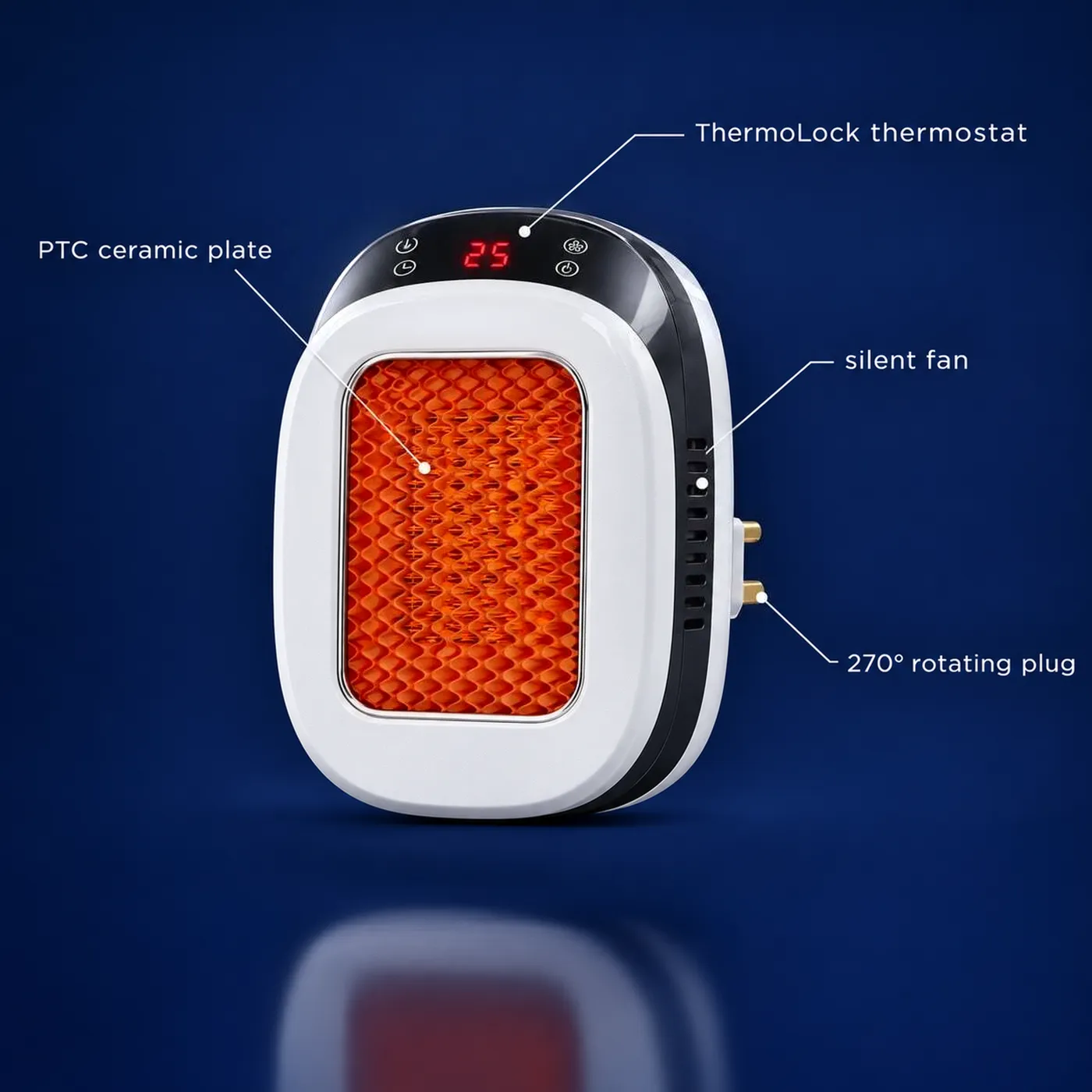
Varmo's PTC ceramic plate is specified to reach full heat in about eight seconds. Its stated room-warming time is around 10–15 minutes for a suitable normal room. Those are different claims. Neither means every room will reach a chosen temperature within that period.
Cold walls, draughts and an open doorway can dominate the result. If a 600 W heater cannot match ongoing heat loss, it may never reach the target on a cold day. A more powerful conventional fan heater may then be the more practical option, despite its higher full-power hourly cost.
Are ceramic heaters quieter and better for dust?
There is no reliable rule that a ceramic heater is quieter. Noise depends heavily on its fan and construction. A conventional fan heater on a low setting might be less noticeable than a different ceramic model. Compare measured sound data where available rather than relying on the element description.
Varmo is described as having a silent fan, but this guide has no independent decibel results. We also cannot support a universal claim that ceramic heaters never smell, burn dust or last longer. Dust can collect in many appliances and may cause odour or obstruct airflow.
Follow the manufacturer's cleaning guidance with the heater unplugged and cool. Do not push objects into the grille or spray cleaning fluid inside. If there is smoke, a persistent burning smell or unusual operation, stop using the heater rather than assuming the smell is harmless.
Which thermostat features are worth paying for?
A useful thermostat lets you choose a comfortable temperature and stops unnecessary heating once it is reached. Clear controls matter more than an impressive temperature range. Varmo's ThermoLock range is 15–32°C, but the highest setting is not normally a sensible target for everyday room comfort.
Check whether a competing heater offers adjustable power as well as a thermostat. A 2 kW model with lower settings may be more flexible than its headline wattage suggests. However, a thermostat that cycles the element off does not necessarily mean the appliance runs at a lower wattage while heating.
Sensor position also matters. Warm air around the appliance can differ from conditions across the room. A separate thermometer helps check the occupied area. No thermostat should be treated as proof of exact, uniform temperature everywhere, particularly in a draughty or irregularly shaped room.
When should I choose a basic fan heater instead?
A conventional fan heater can be a reasonable buy for brief, supervised heating where greater output is needed. Some offer several power settings and simple controls at a modest purchase price. Compare the actual specification and suitable placement rather than rejecting it solely because it uses a wire element.
Varmo may fit better when one normal enclosed room needs modest heat and a suitable wall socket is available. Its £59 purchase price, remote and compact format need to be weighed against cheaper alternatives. There is no automatic financial saving from changing an existing working heater.
If you dislike moving air, consider a fanless option instead of choosing between two fan-based products. If the real problem is poor insulation or inadequate fixed heating, address that too. The best choice is the one that safely meets the heat requirement without paying for unnecessary features or unsupported efficiency claims.
| Example | Output | One hour | Four hours |
|---|---|---|---|
| Varmo ceramic heater | 600 W | 15.8p | £0.63 |
| Any 2 kW resistance heater | 2,000 W | 52.6p | £2.11 |
| Any 3 kW resistance heater | 3,000 W | 79.0p | £3.16 |
Pros and cons
Good points
- Varmo's compact, socket-mounted format can suit a clear wall position in one normal room.
- Its thermostat and remote provide more control than a basic heater with only an on/off switch.
Things to know
- Ceramic technology alone does not establish lower bills, lower noise or longer life.
- A higher-output conventional fan heater may be more suitable when the room needs more than 600 W.
Who it is not for
We'd rather you buy the right heater than return the wrong one. Varmo is probably not for you if:
- You expect a ceramic element to produce several times more heat from each unit of electricity.
- You need verified independent noise or durability results before choosing.
- The room needs substantially more output than a 600 W appliance provides.
How we worked this out
Costs are calculated as rated power in kW multiplied by hours and 26.32p/kWh. The table assumes continuous full output and does not estimate thermostat duty cycles.
The rate is Ofgem's average Direct Debit electricity figure for 1 October–31 December 2026. Regional and tariff differences apply; electricity has no VAT during October 2026–March 2027.
Standing charges and purchase prices are excluded. This is a power-cost comparison, not an independent performance, safety, sound or lifespan test.
More questions answered
Sources
Facts on this page were checked against these independent sources. Energy prices use the Ofgem price cap for 1 October to 31 December 2026.
Ready to warm the room you actually use? See Varmo bundle prices.
Get your Varmo
Launch price: half off. Buy more and pay less per heater.
You'll pay £99.00 today · Free tracked UK delivery · No subscription
Secure checkout by Shopify
- Free tracked UK delivery
- Money-back guarantee
- Secure Shopify checkout